
A $100 fee on a $1,000 two-week instant loan translates to roughly 260% APR. That number sounds predatory. And for borrowers who roll the balance forward, it is.
That APR figure hides a different calculation. The flat dollar cost of the loan compared to the flat dollar cost of missing the bill it covers.
Freelancers and gig workers live on payment cycles that never sync with monthly due dates. The paycheck gap creates a math problem, not a spending problem.
This breakdown covers when instant loans make financial sense for irregular earners and when they make everything worse.
How Instant Loan Applications Move Money So Fast
The speed of instant loans comes from what lenders remove from the process. There is no branch visit, no appointment, no paper documentation cycle. The entire workflow runs through a digital form that takes five to ten minutes to complete.
The Application-to-Cash Timeline
Applicants submit identification, proof of income, and bank account details through a lender's website or app. The lender runs either a soft credit check or an internal database check.
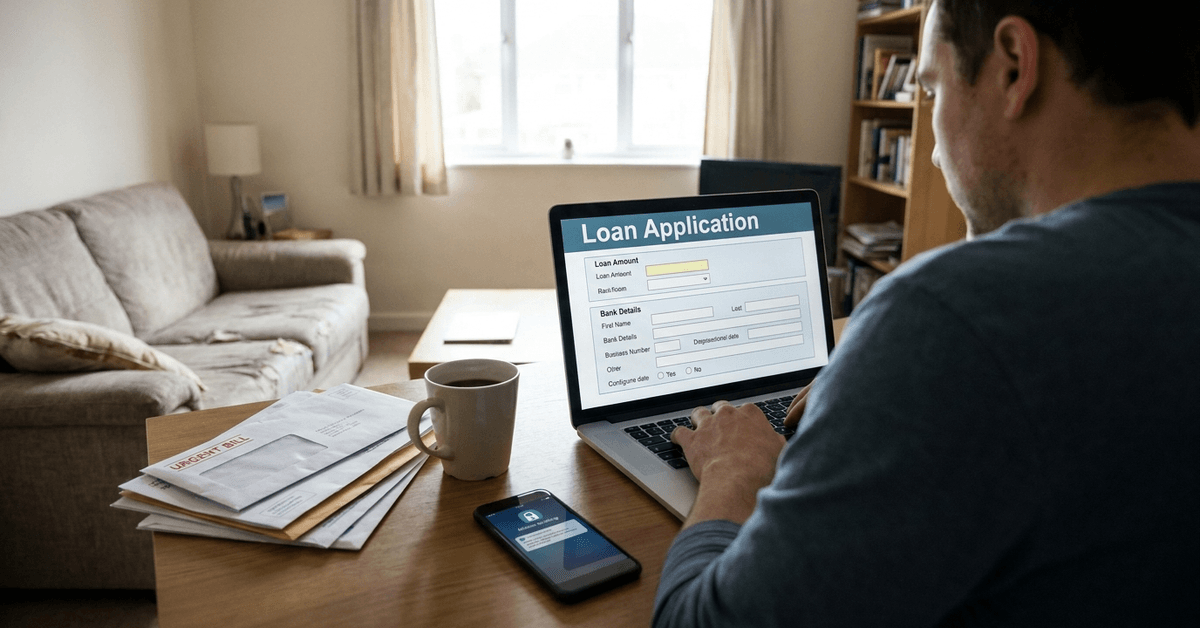
Neither requires a hard credit inquiry, so the application itself does not ding a credit score.
Approval decisions arrive within minutes on most platforms. Fund transfers land same-day through some lenders, though others take until the next business day depending on the receiving bank's processing speed.
Eligibility Without a High Credit Score
Traditional banks reject applicants below a certain credit threshold. Instant loan lenders operate differently.
A steady income stream matters more than a FICO number in these applications, which is exactly why gig workers and freelancers can qualify where they would get turned down for a standard personal loan.
That accessibility has a price tag attached to it, though. Lenders offset higher default risk by charging steeper fees. The tradeoff is real and measurable.
The Fee Math That Changes the Entire Decision
This is where most advice about instant loans falls apart. The standard guidance says to avoid them entirely because the APR looks enormous.
I think that advice fails freelancers earning $3,000 to $5,000 per month on platforms like Upwork or DoorDash, because it ignores what happens when the bill goes unpaid.
APR vs. Flat Fee: Two Numbers Telling Different Stories
A $50 fee on a $500 loan repaid in 14 days produces an APR above 260%. Sounds terrifying. But the borrower paid $50. The APR inflates because the loan term is short, not because the dollar cost is extreme.
Compare that to a credit card cash advance. A typical card charges a 5% transaction fee ($25 on $500) plus interest starting immediately at 25% to 30% APR with no grace period. Hold that advance for 30 days and the total cost lands near $35 to $40.
Cheaper than the instant loan, yes. But the credit card option requires having a credit card with available balance, which many gig workers do not.
When the Loan Fee Costs Less Than Skipping the Bill
A missed rent payment can trigger a late fee between $50 and $150 depending on the lease. A missed utility payment can lead to a disconnection fee plus a reconnection charge, often $75 to $200 combined.
A missed car insurance payment can lapse coverage entirely, and reinstating it costs more than the original premium.
Run those numbers against a $30 to $75 instant loan fee on a $500 borrow, and the math shifts. The loan fee becomes the cheaper option when the alternative penalty exceeds it. I would take a $50 instant loan fee over a $150 lease violation penalty from my landlord every single time.
Instant Loans Compared to Credit Cards and Personal Loans
Not every emergency demands the same borrowing tool. The differences between options come down to speed, cost, and who can get approved.
| Feature | Instant Loans | Credit Card Advance | Personal Loan |
|---|---|---|---|
| Speed | Minutes to same-day | Immediate if balance exists | Days to weeks |
| Typical Cost | $30-$100 per $500 | $25-$40 per $500 (30 days) | Lower APR, longer term |
| Credit Requirement | Low or none | Existing card needed | Moderate to high |
| Repayment Window | 14 to 30 days | Revolving | Months to years |
| Best Scenario | Single emergency, fast repayment | Short-term if card available | Planned larger expense |
The personal loan wins on total cost for anything above $1,000 or any repayment period longer than 30 days. The instant loan wins when the borrower needs money today, can repay within two weeks, and does not hold a credit card.
Spotting a Bad Lender Before Sharing Personal Data
The instant loan market has regulated lenders operating under consumer protection rules and unregulated operations hiding behind slick websites. Telling them apart takes about five minutes of checking.
Missing APR and Total Repayment Disclosures
Legitimate lenders are legally required to display the annual percentage rate and the total amount due at repayment.
The Consumer Financial Protection Bureau maintains resources on what disclosures borrowers should expect. Any lender that buries this information or requires an account creation before showing fees is a red flag.
Data Security on Lending Platforms
Every lending site should run HTTPS encryption. The URL bar should show a lock icon. Beyond that, check for a physical business address, a registered lending license number, and third-party reviews on sites like Trustpilot.
Red flags to watch for when evaluating an instant loan provider:
- No APR disclosure anywhere on the site before application submission
- Requests for upfront payment or "processing fees" charged before loan approval
- No physical address or lending license number listed on the website
- Pressure tactics like countdown timers or "limited availability" messaging on the application page
Smart Borrowing Rules for Freelancers on Irregular Pay
A single instant loan repaid on time costs a fixed fee and disappears. The damage starts when loans roll over or stack. One becomes two, two becomes a cycle, and the fees compound into a balance that eclipses the original emergency.
Gig workers considering an instant loan should run through a short checklist before applying:
- Calculate the exact penalty cost of not borrowing: late fees, reconnection charges, coverage lapses
- Confirm a specific incoming payment date: a pending invoice, a scheduled direct deposit, a platform payout cycle
- Set the repayment amount aside the moment that income arrives, before spending on anything else
- Cap the borrow at the bill amount only: do not round up, do not borrow extra "just in case"
That last point trips up a lot of people. A lender may approve $1,000 when the actual bill is $400. Taking the full $1,000 means paying fees on $600 of unnecessary borrowing.
The Rollover Trap
Extensions and rollovers sound helpful. They give more time to pay. But each extension adds another fee cycle.
A $50 fee on a two-week $500 loan becomes $100 after one rollover and $150 after two. Three months of rolling over a $500 loan can cost $300 in fees alone. The loan never shrinks. Only the cost grows.
Questions People Ask About Instant Loans
These are the questions that come up most when freelancers and gig workers look into short-term borrowing for the first time.
- Q: Do instant loans show up on a credit report?
The application usually involves a soft credit check, which does not appear on credit reports. Late payments or defaults, however, can be reported to credit bureaus by the lender or a collection agency they sell the debt to. - Q: Can I get an instant loan if I am paid through gig platforms like DoorDash or Fiverr?
Most instant loan lenders accept bank statements showing regular deposits as proof of income. Platform payouts that hit a bank account on a consistent schedule generally qualify, even without traditional pay stubs. - Q: How much can I borrow through an instant loan?
Loan amounts typically range from $100 to $2,000 for first-time borrowers. Some lenders increase the limit after a borrower completes one or two successful repayment cycles. State regulations also cap maximum amounts in certain jurisdictions. - Q: Are instant loans legal everywhere?
Regulations vary by state and country. Some U.S. states cap fees or ban payday-style lending entirely. Others allow it with few restrictions. Check your state's attorney general website or the CFPB database for local rules before applying. - Q: What happens if I miss the repayment date?
Late payments trigger additional fees, and most lenders begin collection efforts within days. Some report the delinquency to credit bureaus after 30 to 60 days. Contacting the lender before the due date sometimes opens a hardship plan or a single extension without penalty.
Conclusion
Instant loans charge real money for speed, and the cost only makes sense when the alternative costs more. Freelancers and gig workers face this calculation more often than salaried employees ever will.
Running the penalty math before borrowing separates a smart financial move from an expensive mistake. The fee is the price of timing, so make sure the timing is worth it.